

The education sector has witnessed a dynamic revolution in the last year. I prefer terming it as a ‘revolution’ because the sector brought to light some momentous transformations that one couldn’t have imagined so soon in this lifetime. Not only did one witness the accelerated adoption of online education, digital pedagogies, and remote online examination with much enthusiasm, but a wide range of groundbreaking solutions such as online proctoring and AI-enabled software, to name a few, offering significant benefits also came to the fore.
Every other day the highly competitive education market provides solutions to some of the most urgent challenges by addressing individualized concerns. They are doing this by either launching innovations or upgrading existing technologies. This is not only providing a myriad of benefits favoring the education system and its stakeholders, but such incredible solutions are giving birth to some rapidly evolving changes that is reshaping how the sector functions. And amongst the various tech-enhanced rudimentary offerings making headlines, one of the most ingenious solutions that’s attracting my attention is the use of technology to improve the process and experience of examination marking procedures.
Digital evaluation is the latest in an extensive list of educational technologies that has been introduced to mitigate the stress and challenges associated with pen-and-paper marking and improve the exam evaluation process. Factually speaking, it is not something new. There are various success stories of renowned entities such as the Cambridge University, Mumbai University, the CBSE Board that have already adopted this highly cost-effective on-screen marking system, thereby underlining its importance and value. However, for many other entities this invention slipped unnoticed into the night.
But now is not the time to take digital evaluation with a grain of salt. Given the current situation embroiled with the ongoing health emergency and extended restrictions on gatherings at exam centers, the need to ensure continuity in examination evaluation schedules is paramount. Hence, it is essential to shed light on it, encourage academia, and renew their interest in beginning their shift from traditional exam evaluation to a digital evaluation system.
Digital evaluation is an online paper checking system that automates the entire exam evaluation process, thereby making it more transparent and efficient. This hassle-free on-screen evaluation solution saves ample time, effort, and money to evaluate answer sheets and efficiently manages the entire evaluation process using real-time analytics and a dashboard.
A digital evaluation system is a cloud-based solution that transforms the existing paper-based evaluation process into an online one. Digital copies of answer sheets are easily uploaded online from distinct locations and consolidated in one place for evaluation, eliminating logistical complexities and physical handling of answer sheets. This on-screen marking system is easy to access and brings forth many advantages that ensure a seamlessly scalable, secure, and swift evaluation of any answer script. A digital evaluation system can be adopted by Universities, Institutes, Schools, Boards, and recruitment bodies for examination purposes.
From making an otherwise cumbersome task easy and efficient to ensuring accuracy and security of marking and results; from enabling new ways for people to work together to reducing the possibilities of delayed results; the on-screen evaluation system is an impartial mechanism that can ease one of the most manual, tedious, and cumbersome processes for professors and administrators in an instant.
How is the move to an on-screen evaluation system a catalyst to create a more powerful influence on the education industry?
Let us rewind a bit and find out how.
Checking a students’ answer sheet is considered to be a vital part of a teacher’s workload. But the task of manually evaluating answer sheets, in reality, is quite cumbersome and arduous. It is a critical yet huge administrative task that takes up a lot of time and energy. The process itself is also unnecessarily lengthy, involving numerous activities beyond one’s imagination.
Let me break it down for you.








Sounds so elaborate and intricate, right? It is. And this is when we have not even considered the amount of time, money, and resources an institute invests throughout the process. The logistic challenges, discrepancies involved in handling so many answer sheets and the state of teachers who go through this exhaustive process under the pressure of strict deadlines and efforts make the traditional approach to exam evaluation onerous.
If you still think exam evaluation is child’s play, let me elucidate some more problems involved in a traditional exam evaluation process.

A typical traditional exam evaluation process requires constant administrative control to ensure there is no compromise. The administrator manually collects all answer sheets and gets logistics organized to transport physical papers from examination centers to a central office and then to separate locations for evaluation. Certain times, paper checkers are not local; hence papers have to be sent out, and the institution ends up bearing the back-and-forth courier cost for huge bundles as well. Additionally, when re-evaluation is involved, the exam checkers have to send the physical sheets ahead to either the moderator or examiner, thereby adding more logistics, costs, and workforce to an already exhausting process. For instance, a recent CBSE board exam witnessed 1.5 crore answer sheets from around 3000 exam centers across India, and it will be delivered to the homes of the board examiners.
To err is human, and you will be surprised to see how vulnerable the traditional exam evaluation process is to errors. Callous mistakes such as Teacher marking down a child for getting the correct answer (but not in the right way) happen as time-pressed evaluators have their criteria for evaluating an answer sheet quickly. Similarly, a Teacher gives 80 marks to a student who had scored just 8 in the paper is common since over-burdened evaluators oversee specific questions or answers and tabulate them wrong, thereby awarding wrong grades to a student. There have also been incidents where examiners get bored of checking the same thing or frustrated by illegible handwriting, thereby leading to a high margin for flaw during digital evaluation of answer sheets.
It is not always possible to have exam checkers present in a centralized location for evaluation. For instance, given the current scenario, exam checkers prefer taking exam sheets home to evaluate, or scripts are sent to other regions for marking. Hence, one can argue that the level of transparency in evaluation cannot be the best, keeping in mind the magnitude of mistakes and the variation of marks that occur without constant monitoring and supervision. It is difficult to ascertain any unfair or unethical activity, such as biased evaluation, whether conscious or unconscious.
If one must count, there are many stakeholders involved in the exam evaluation process. It includes the personnel involved with administrative work and the list of evaluators who undertake checking, re-checking, and inspecting final evaluated answer scripts. Considering this level of involvement, one can expect some level of tampering, complication, and quality compromise. Adding to this, an absence of checks and controls for examination controllers, moderators, and evaluators to eliminate such complex involvement, the evaluation process becomes anything but smooth and streamlined.
In my opinion, a traditional exam evaluation timeline would stretch up to four months at least, considering the sheer volume of answer sheets and the lack of collaboration. Add to that inflexibility, the necessity to peer review for quality assurance and overtly complex logistical issues, and the entire evaluation activity becomes indeterminately time-consuming.
The traditional exam evaluation system is often blamed for delays and coordination problems, which for students facing college application deadlines is a nightmare. This drawback can be attributed to several constraints, such as a variety of answer sheets. Scripts are not always multiple-choice questions with a ready-to-use answer key; the answers are anything from lengthy essay type to diagrams and complex equations that require utmost concentration and time when checking. But their checking progress is slow because the exam evaluators are involved in long and never-ending meetings to chalk out all details and compile exam-related data making it more challenging to meet the deadline.
A physical exam evaluation process is so demanding that it is difficult to constantly track everyone’s pace, progress, or the timeline of the evaluation submission in real-time. Hence, the inability to determine where the delay is happening so that the person can be helped accountable is a bottleneck that is often difficult to rectify.
Academic honesty from every education stakeholder is extremely important, else use of wrongful checking mechanisms or any calculation error during the exam evaluation process places the credibility of the institute at stake. Eventually it can have grave consequences on the institution.
The safety and security of physical answer sheets are of utmost priority for all institutes. But there are times when physical data becomes vulnerable to leakage, theft, loss, gets soiled due to negligence. There have been instances of answer sheets getting misplaced, such as - ACT answer sheets from Hollywood Hills High School get lost in the mail. Now, this is quite an inconvenience that is attributed to external factors. But since students’ future is at stake, safeguarding, treading with caution is vital.
Few know of this, but the education sector has a regulatory obligation to comply with the Right to Information (RTI) Act. Under this, those students who are not happy with the given evaluation and are sure of their performance in the exam can make re-evaluation and re-calculation requests. The university or institute must comply. But storing, retrieving, and checking specific physical answer sheets within a stipulated time is quite a hassle.
As you can see, the conventional paper-based marking system is embedded with some irreconcilable issues. It is caught up less in checking and more in laborious tasks such as sorting, evaluating, and preserving answer scripts. Given that one cannot deny the importance of credible exam evaluations in a student or candidate’s future graph as it is an indicator of potential and progress. Hence, it becomes an exam checker’s primary purpose to make a reliable evaluation about the capability of a student. But if the process is going to be flawed by such challenges, it will be detrimental to a student’s future and impact the institution’s reputation as well. The importance of a credible exam evaluation system thus, cannot be overlooked. And considering the challenges associated with the traditional system that we have already spoken about at length above; educators must invest in a viable technology that streamlines the whole process.
Does there exist a solution that enables an efficient and gratifying exam evaluation?
Yes. One can set the ball rolling by adopting digital evaluation as an approach.
I can already begin to imagine the massive reduction in a center’s administrative and logistic load with no storing, handling, distributing, packing, collating, maintaining or returning of answer sheets and tabulation sheets in an on-screen evaluation system. No need to manually circulate sheets or involve an entire workforce in getting things streamlined. Laborious and repetitive tasks are also drastically reduced as everything is on screen and done via a computer, keyboard, and mouse. The focus and attention is solely on error-free and fair marking.
Let us explore how this key solution works.
A rightly done online evaluation of answer sheets benefits every education stakeholder. Digital evaluation of answer sheets doesn’t just cut time but also costs as exam centers save adequately on logistics. Realistically speaking, it replicates the manual procedure so well that you can also begin to realize certain benefits that are not offered in the manual exam evaluation method once you employ it.
So, if you’re a University, an Institute or a school looking to venture online to streamline their on-screen marking system, these below-mentioned benefits derived are a clear signal indicating it is time to shift attention to the use of digital evaluation software.
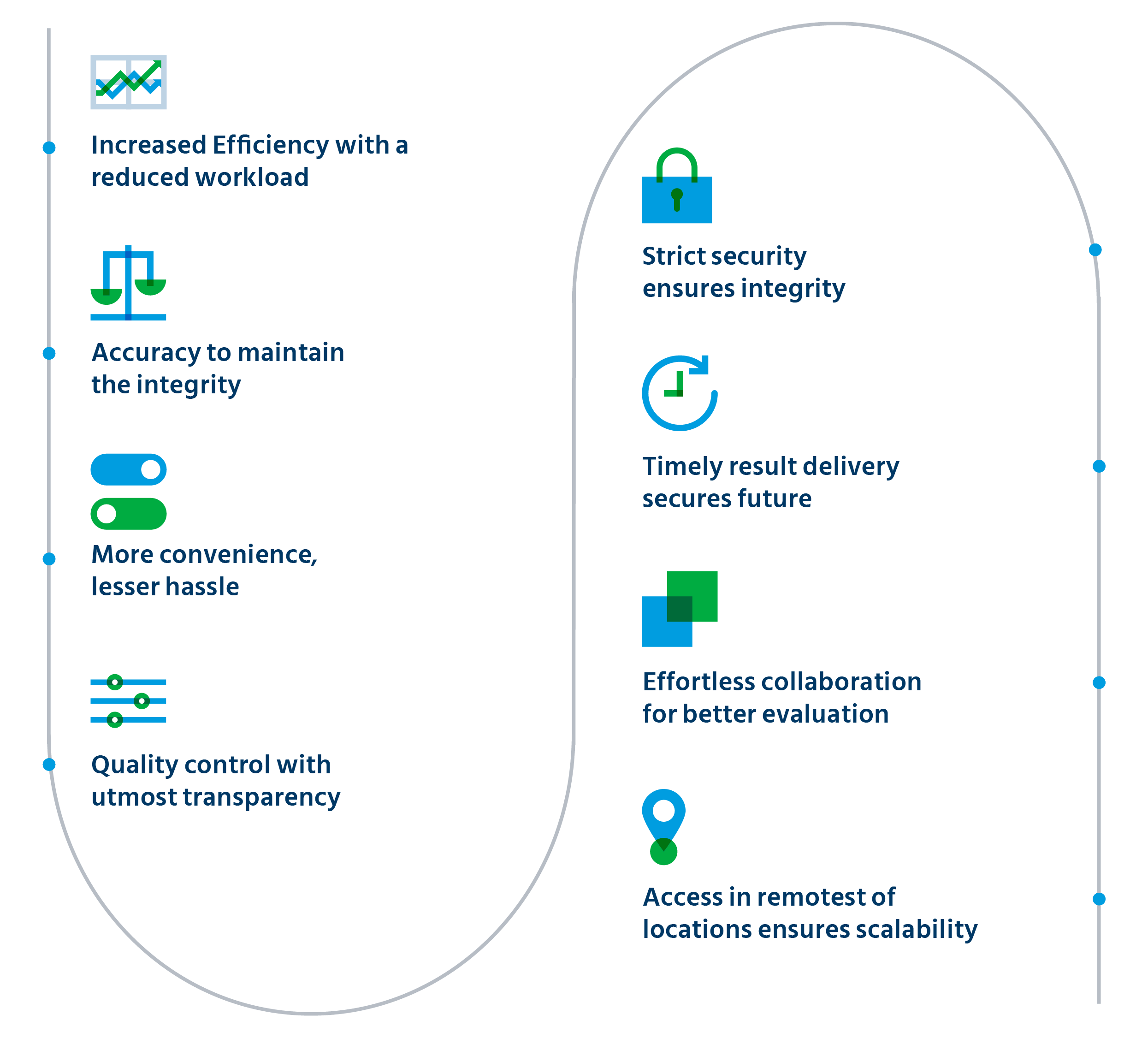

The immediate benefits of on-screen evaluation of answer sheets are for the evaluators who can eliminate their administrative tasks such as storing, circulating, tracking, and collecting answer sheets and pay focused attention to reliable marking and accurate result generation. There is reduced stress and increased productivity that in turn speeds up the online screen marking process.

With less human intervention and a more effortless and focused approach on evaluation, the level of mistakes that happen in the conventional approach when overburdened are drastically reduced. Additionally, a collaborative evaluation feature ensures timely intervention of peers, which helps detect any anomaly in the checking or marking procedure. The error is either instantly rectified, or corrective action is taken for a reliable, accurate and prompt result generation. This level of accuracy negates any chance of bias or human error and safeguards an institution’s integrity and a student’s career.

An on-screen marking system ensures the integration of information in one place. All the data is centralized and made readily available to concerned stakeholders online via user permissions. Rather than scouting through bundles and piles, making requests to centers or following complex routine procedures that are often time-consuming, digital evaluation software allows role-based access to the system as well as easy sharing of data. The more convenient the workflow, the more effortless is the evaluation.

A salient feature of an online evaluation system for teachers is consistent quality control through every stage of the digital evaluation process. Not only is the head examiner monitoring the checking comprehensively and effectively, but at an early stage in marking cycles, it can intervene in the marking process and resolve any issue before it is too late. Concurrently, the number of activities involved in the digital evaluation of answer sheets compared to the traditional process is minimal. Therefore, issues with unassessed sheets or soiled and damaged sheets do not occur. This invariably safeguards quality.

One can argue that since exam evaluators get easy access to answer sheets online, how does security come into play? The thing is, all sheets, after being scanned and uploaded online, are stored on a secure server. This eliminates any form of data theft, loss in transit, leakage, or misuse of confidential data. Secondly, evaluators get role-based access. Thirdly, the level of transparency is such that it is easy to trace errors and hold the concerned individual accountable. More so, just like the traditional process identity of the exam-takers is also hidden to avoid any wrongful publishing of evaluation.

When students put in long hours and hard work in giving their exams, they expect a fair and timely evaluation and result delivery as their future depends on it. Hence, by employing digital evaluation software, exam evaluators significantly reduce the time taken to check without compromising the necessary quality. Timely intervention, elimination of repetitive tasks, and reduced bottlenecks optimize time and effort, ensuring a quick and reliable turnaround of evaluation and results.

A digital evaluation software fosters dynamic forms of communication and collaboration online, asynchronous, and synchronous. This makes it easy for various evaluators to connect and take assistance from peers and supervisors when they have any confusion regarding marking or grading. This is one advantage that is not possible in the traditional exam evaluation process.

Given the current situation wherein it is risky for exam evaluators to gather and correct answer scripts, an online evaluation system for teachers ensures that with the help of basic internet and a computer, they can check papers anywhere, anytime, including on-the-go easily. Checkers are not hindered by their geographical location; instead, they are able to scale their evaluation.
Digital evaluation is the last straw in the education landscape empowerment bucket. I mean we have already moved from the brick and mortar education and examination infrastructure, why leave evaluation behind? Educators are constantly looking to improve educational outcomes, and in my opinion advances in technology and the advent of digital evaluation software can do justice to the concept.
But choosing the right digital evaluation software can be tricky given the massive proliferation. My advice is, begin with a solution that is leveraged by low bandwidth and offers context-appropriate solutions. It should not only harness the best of technology to ensure that it continues providing results to candidates accurately and promptly but should also facilitate faster result generation, often within the stipulated timeline. That way it saves the time of the marker and is also a massive savior of cost.
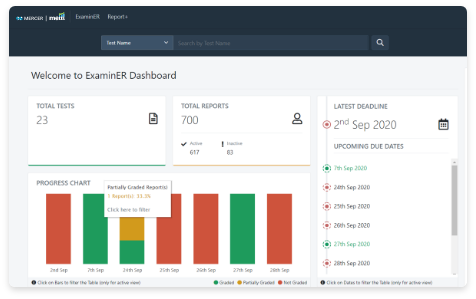
Mercer | Mettl ExaminER is a future-ready online question paper-marking and evaluation software that helps assess a virtual evaluation system, enabling a seamless process for administrators and evaluators. The software allows for a hassle-free assessment of both subjective and objective questions, making it a perfect and well-rounded solution for all kinds of exam evaluation. It also lends exam-givers unparalleled convenience and ease in the result declaration process. An intuitive dashboard offers them complete clarity on the progress, with a host of other features that ensures easy collaboration and real-time updates on the progress made.
Each time I come across the term exam evaluation, I’m instantly teleported to a memory of my high school days. Whenever our examination dates would close in, the enigma around our teachers would arise. The reason being, we never saw a half of them throughout the examination duration. Naïve rumor mongers, budding storytellers, they all had a fascinating story to spin around their disappearance. And the whole school even used to buy into it, till some students accidentally found them in a place least visited by many- the school library. Our beloved teachers huddled up in the back of the library evaluating vast bundles of paper- our answer sheets.
While we didn’t take up much time solving this mystery, it was quite later that the mystery behind manual evaluation became known. Late declaration of results, exhaustive pressure, and lack of accountability have often been some of the biggest problems associated with exam evaluation that never really had a solution. But with the advent of digital evaluation, attention needs to be directed toward it.
Give the changes and advances in the testing mechanism, the use and adoption of digital evaluation plays a pivotal role in filling up the evaluation gaps. It also sheds light on some more significant issues in the educational evaluation system that was otherwise rarely visible.
It is about time academia revisits what the purpose of an evaluation is and how it should work. This will lead to a more strengthened and accelerated adoption of on-screen evaluation. On-screen marking of scanned paper scripts is a part of a much more comprehensive strategy that reimagines the possibilities of the digital age. And considering how fast the future is changing, it is up to us how we manage to walk along with it.
It would be interesting to hear your views on the virtues of on-screen marking and the traditional paper-based marking system.
Are you still contemplating the move, or have you tried your hands at a digital evaluation system?
Let us connect and discuss it in detail.
Here are some answers to the frequently asked questions around digital evaluation app, digital evaluation in India and an on-screen evaluation software:
Originally published May 31 2021, Updated August 12 2021

Shirisha has been helping countless brands gain traction with her content. Her deep understanding of the education sector and sound knowledge of technical skills have helped her structure the most creative solutions for key stakeholders. Shirisha has also ghosted pieces for several industry honcho’s successfully published both online and offline. When she's not keeping up with the world, you're sure to find her catching up on bollywood stories or gramming for fun.
Online examination, also known as virtual examination, is conducted remotely on a computer with high-speed internet. Like a classroom exam, it is time-bound and usually supervised through a webcam and proctor, making it cheating-free, secure and easily scalable.

Highly secure and seamless online examination platform
Know More

Don't defer your semester exams, conduct virtual semester exams in a secure and scalable manner
Know More

Conduct 1 lac+ proctored online entrance exams in a day
Know More


Thanks for submitting the comment. We’ll post the comment once its verified.





 Behavioral Competencies
 Cognitive Competencies
 Coding Competencies
 Domain Competencies





Would you like to comment?