acf domain was triggered too early. This is usually an indicator for some code in the plugin or theme running too early. Translations should be loaded at the init action or later. Please see Debugging in WordPress for more information. (This message was added in version 6.7.0.) in /var/www/html/wp-includes/functions.php on line 6121

It is crucial to have a successful leadership team in place that is exceptional at leading people and driving business growth in a sustained manner, in order to succeed in any business. The leadership of a company is responsible for creating and maintaining a workforce that embodies the company’s mission and vision in a way that enables the organization to grow in the right direction consistently.
The term leadership development refers to any activity that forms a part of the organizational effort to develop its leadership team. Leadership development involves planning and execution of two tasks primarily- identifying talent that has the potential to lead the organization; retaining and nurturing them to take up leadership roles. Companies should have an efficient leadership development process in place to ensure continued leadership success.
Different organizations carry out leadership development in different ways and for different reasons. The methods that they follow are based on their specific requirements, objectives, and the resources at their disposal. We studied various aspects of the leadership development process such as – why to train, who to train, what to train, and how to train. Most leadership development programs fail because organizations are not clear on these three aspects.
Leadership development can be carried out to create an internal pipeline of new potential leaders or to train & develop existing leaders. Organizations should have their leadership development objectives properly laid out to warrant that their efforts are invested in the right direction.


Our survey revealed that most organizations carry out leadership development to broadly meet three objectives:
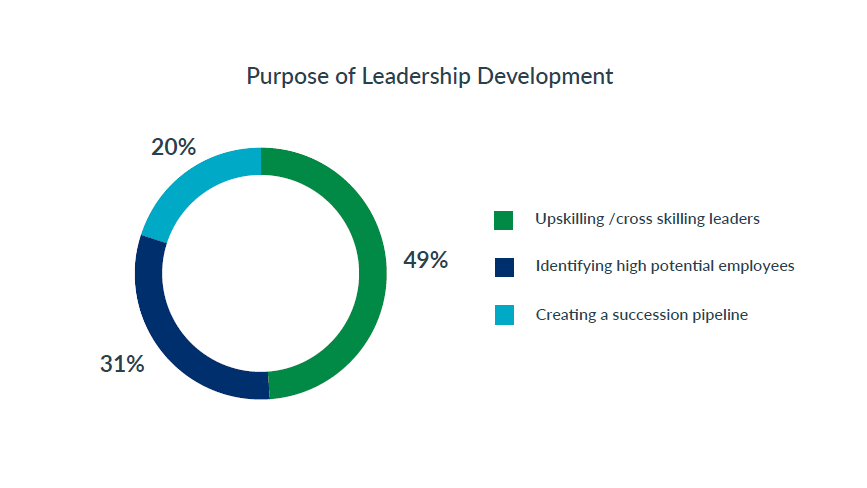
Leadership skills are very different from the skills that are needed to excel in individual job roles. Often in companies, people land up in leadership positions not because they possess these leadership skills but as a result of gradual career progression. Often leaders (especially new leaders) lack the skills needed to lead people and drive organizational growth in the right direction. Hence the biggest focus area of most organizations when carrying out leadership development is to equip their leaders with the right skill set that will help them succeed as a leader. 49% of organizations carry out leadership development for the sole purpose of training & developing new and existing leaders.
Transitioning into a leadership role for the first time is challenging. New leaders are presented with a lot of additional responsibilities as compared to their previous roles. Their role has very high stakes attached to them and any misstep has ramifications that they were not faced with previously. It is crucial to train them thoroughly to make them ready for their new role and responsibilities in the most seamless and effective manner.
New leaders pose a lot of challenges for any organization. Absence of the right training can cause new leaders to deliver sub-optimal performance at work that can ultimately result in them leaving the job due to poor job satisfaction.


Our survey revealed that 20% of new leaders have trouble adjusting to the new organization’s/team’s culture and that impacts their performance adversely. The second most significant challenge that organizations face with new leaders is their low learning agility, followed by their inability to network, lead people, and drive business results. Finally, as discussed before, early attrition is another major problem that new leaders present to organizations. New leaders are under a lot of pressure to learn fast, perform, and deliver results consistently. Lack of proper training to equip themselves for their new roles can cause many to call it quits.
Leadership development of existing leaders involves identifying their skill gaps & development areas and addressing them by providing relevant training and support. Most organizations carry out 360-degree assessments or leadership assessments to identify training needs in existing leaders.
Paul Schempp, Founder of Performance Matters, shared his view on why organizations fail to train leaders successfully and how to do it right- “The biggest mistake I see organizations make in leadership development is the lack of experience integration. For new leaders, mentorship programs are extraordinarily helpful as the budding leader can better glean the lessons learned from experience with guidance from a mentor. For experienced leaders undergoing training or development—their past experiences need to be recognized and incorporated into their new experiences. Failing to do so makes any new information seem irrelevant to the leader.”
Organizations should ideally identify employees who have the potential to lead from early on so that they can work on retaining and nurturing them for leadership positions. High performing organizations invest a lot in identifying, training, and developing high potential employees as they have the capability to drive organizational growth.
Helen McPherson, Principal Consultant at McPherson Consulting shared why organizations fail to identify high potentials successfully – “One pitfall I see is organizational politics influencing the succession pipeline and high potential identification process. An individual with an active, hands-on manager will almost always advance faster than a higher-potential individual with a manager who does not care about employee development.”
The majority of high potentials place a high degree of importance on being identified as a high potential. The probability of these employees leaving an organization is very high if they feel that the organization is not putting enough effort into grooming them. Losing high potentials can be extremely detrimental to an organization’s pursuit to develop successful leaders.
Organizations need to create a culture where managers and leaders are motivated to identify and develop high potentials.
Helen suggests how organizations can successfully identify and develop high potentials-“The best way for organizations to identify and prioritize succession planning and leadership development- and to avoid the above pitfall- is to create a culture that rewards managers for identifying, developing, and advancing their high-potential employees.”
Not having a ready internal succession pipeline can cause derailment of an organization’s business operations from time to time as the organization is not equipped to provide an immediate replacement for a leader, whenever such a requirement arises. Organizations without a succession pipeline must hire talent from the outside every time a leadership position becomes available. Leadership hiring- as discussed in our Leadership hiring trends 2019 report, is a very costly and time-intensive activity. The process of leadership hiring takes three to six months (average), after which the newly hired leader takes another six to twelve months to get settled in the new role and start delivering results. Most organizations cannot afford to disrupt their business for so long without their performance taking a severe hit.
Cal shares his own experience on why organizations need to leverage their internal talent pool – “Many organizations start by looking for managers and executives outside your possessions before they look inside the organization and take advantage of existing knowledge and relationships internal managers and executives would have that would advantage them to address the current organizational challenges better than someone from the outside.”
In most organizations, Leadership Development is a program that all new leaders are made to go through. The programs are standardized and everyone eligible for this program is provided with the same training.
Organizations need to be cognizant of the competencies that are required to perform each leadership role. Having a job role wise leadership competency framework that is updated regularly to reflect the present and future competencies required to succeed in each leadership role, presently and in the future, is the first step towards accurately identifying who to train and what to train.
Generic leadership development programs are not very effective for multiple reasons:
Identify the competency requirement of each leadership role, taking into account the changing nature of work and future needs.
To create great leaders, organizations must be aware of the kind of leaders they want. They need to be aware of the skills that they want their leaders to have and the type of leadership style that will help them lead their teams better. The kind of leaders that an organization wants differs from job role to job role. Organizations need to have a ready competency framework for each leadership position that will guide them in training and developing leaders for that role. The competency framework should include skills that the previous position holders had, updated to reflect the changing job responsibilities in the present and future.
It’s essential to have an organizational competency framework as the skills required to succeed in a leadership role is very different from that needed to succeed in an individual contributor role. Leaders need to be trained on these new skills to equip them with the abilities required to take care of their continuously evolving job responsibilities.
A competency-based leadership development program has a much higher chance of achieving its desired objective than generic programs. Our study reveals that Leadership success rate and competency framework adoption rate are highly positively correlated (Chart 9). This means companies that base their leadership hiring and development methodology on competency frameworks experience a much higher leadership success rate.
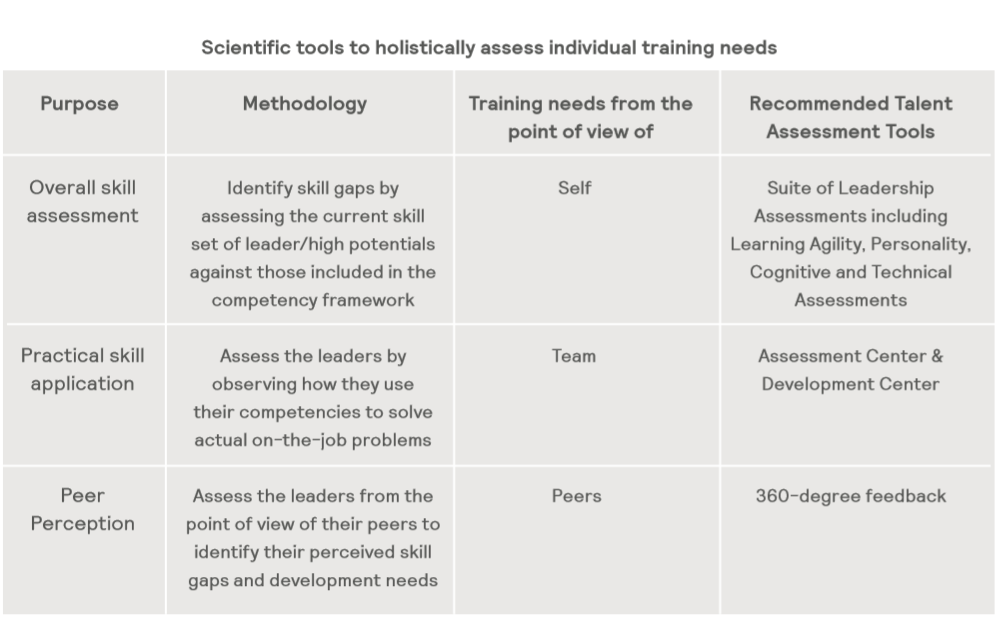
Assess all the new and existing leaders against the competencies that are included in their job role’s competency framework. Use leadership assessment or 360-degree assessment (customized for each job role as per the competency framework) to assess the training needs accurately and enable data-backed decision making. Identify skill gaps in each leader to create an Individual development plan.
Competency-based talent assessment tools such as 360-degree feedback, assessment centers, and leadership assessments allow organizations to identify and develop present and future leaders in a much more effective manner. Assessment tools that are customized for each organization, job role, job level, and bench-marked to meet organizational & industry standards produce much more accurate results.
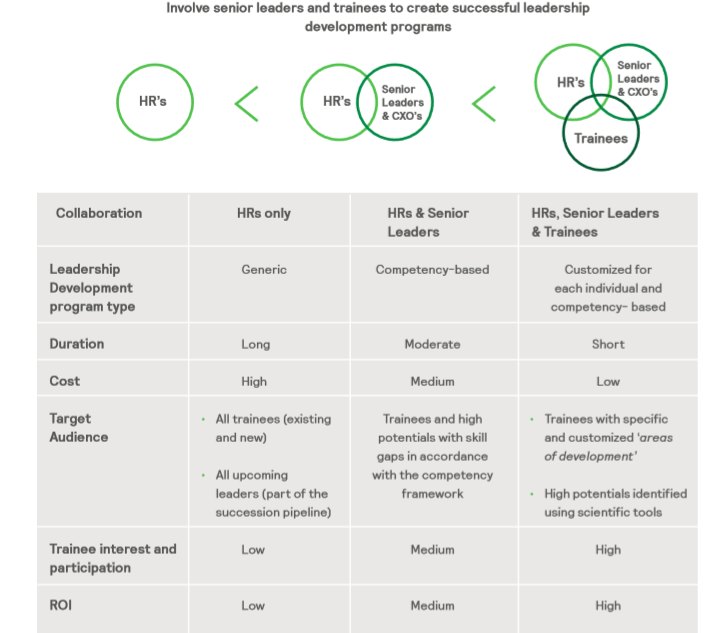
When creating leadership development programs there are certain do’s and don’t that can determine their success rate.
Take into account each leader’s/trainee’s needs, abilities, and preference:
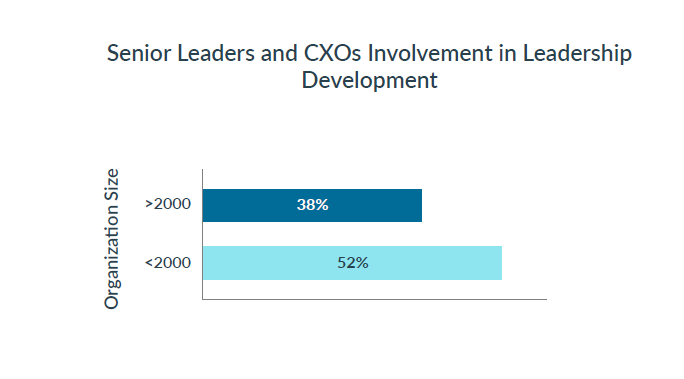
We found out that in many organizations, leaders themselves do not get involved in the leadership development process, and the reasons are obvious- leaders have extremely packed schedules. Getting the support of company leaders and management to contribute to leadership development is crucial as they are in the best position to suggest what skills are required most in leadership positions and how to best develop those skills in budding leaders. 30% of organizations consider the lack of senior management involvement in the leadership development process as the most significant factor contributing to its sub-optimal performance.
Our study also revealed that SME’s leaders partake in leadership development planning, and execution 52% of the time. However, their participation falls to 38% in larger organizations. This is because, most large organizations (47% of them) have specialized Learning and Development (L&D) teams in place to carry out leadership development, which is not the case for most SMEs. 79% of SMEs do not have an internal L&D team, which is why leaders have to become more involved in the L&D process.

The time taken for carrying out leadership development differs based on the target audience. The duration increases with the seniority level of the participating leaders. Also, leadership development programs for newly hired leaders are longer than those for existing employees.
The average time taken to carry out leadership development is eight months. 25% of organizations consider the time required to carry out leadership development as the most significant challenge preventing them from achieving leadership success. Overall, the time required to carry out leadership development is the second biggest challenge that prevents these programs from yielding good results. Ironically, most organizations (36%) take more than a year to complete their leadership development programs.

Although most leadership coaching experts agree that leadership development is not a two-day or one-week activity and the common practice of sending newly appointed leaders on short management training outbound trips is not very effective, extremely lengthy training programs present a different set of problems.
Extensive training programs are not as effective as targeted training programs that are more compact. Long training programs are often unable to attract a high level of interest and participation from the trainees throughout the program, eventually leading to increased absenteeism, which adversely impacts the success rate of these programs. According to Mercer | Mettl’s report State of Workplace Learning and Development – 2018, the biggest challenge for L&D professionals is to get them to attend training. 29% of L&D professions state this is the biggest challenge that they face when it comes to employee L&D. The report also mentions that the biggest reason why employees don’t attend training is that it consumes a lot of time. Employees continuously work to prioritize huge lists of tasks and meetings, and often in all this, training sessions take a back seat to anything that directly contributes towards business growth and revenue.
Most organizations do not have a structured leadership development process. Lack of clarity on job role wise competency frameworks causes organizations to provide generic leadership development programs that fail to yield good results.
Leadership development is not a one-size-fits-all endeavor. Every leader has specific training needs, and every leadership role has a different competency requirement.
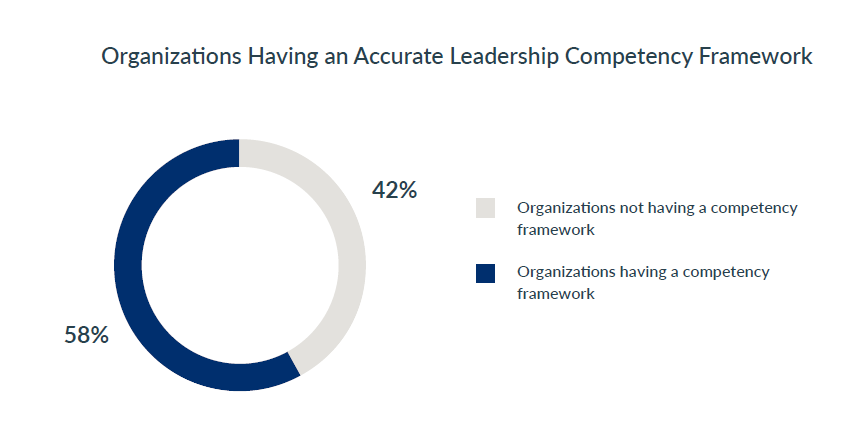
23% of organizations state the lack of a competency-based leadership development process as the biggest challenge that leads to sub-optimal performance of their leadership development programs. This is hardly shocking, as 42% of organizations do not have a leadership competency framework to guide their leadership development efforts.
42% of organizations do not have an existing leadership competency framework
You may also like to read: Top Leadership Development Best Practices in 2020
Originally published July 3 2019, Updated August 5 2021

A leadership assessment is a type of personality test used to identify and develop the competencies required in a good leader - decision-making, empathy, communication, inspiring others, etc. A leadership test can contribute to organizational planning initiatives, such as promotion decisions, succession planning, etc.

Assess & develop leadership competencies to future-proof your business
Know More

Automate Your L&D Programs With Virtual And Blended Assessment Center Development Centers
Know More

Measure the potential of your talent and make objective organizational decisions
Know More


Thanks for submitting the comment. We’ll post the comment once its verified.


 Behavioral Competencies
 Cognitive Competencies
 Coding Competencies
 Domain Competencies





Would you like to comment?