


Organizations are globally experiencing transformation at a phenomenal pace. The continual and rapid changes in the business environment have underlined the need to adapt, adopt and reposition businesses to remain relevant. It is the survival of the fittest, and organizations that brace up and align their strategies accordingly, are likely to stay relevant in the long-haul. However, those that are not equipped to manage the change and ambiguity are likely to become obsolete.
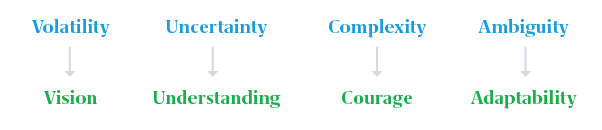
This surge in volatility, uncertainty, complexity and ambiguity is referred to as VUCA. The United States Army first coined the term in the 1990s to describe the stark difference and extreme conditions in Iraq and Afghanistan war zones. Initially coined by the US Military, the term soon resonated with the corporate world after the global crisis of 2008-2009 as businesses began competing in an unpredictable and ever-changing environment. Since then, the concept has been used by organizations to define their leadership attributes and competencies.
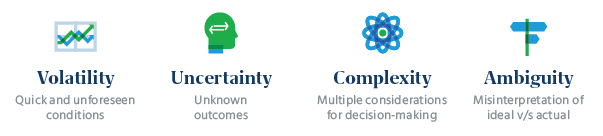
These four components are the foundation for organizations to re-work their current processes and brace-up for the new reality. They catalyze a forward-looking approach, setting the ground for effective management and leadership.
The new-age business reality has multiple dimensions to consider, is less predictable and characterized by how differently organizations perceive, re-align and adapt to the transformation. More than ever, leaders must quickly process a stack of information and decide for businesses to flourish. Evaluating your leaders can be achieved by leadership competencies assessment.
According to the Ashridge Executive Education report, future global leaders must be skilled in negotiating three key factors: context, complexity, and connectivity. The challenge for organizations is to equip future leaders with these ‘three Cs’ instead of merely developing them on traditional leadership practices.
In the VUCA world, leaders need to learn new skills to adapt to the change and unlearn old practices to stay abreast of modern tools and technologies, besides handling their teams. This requires the right leadership competency model under which leaders can be better prepared and positioned to further hone their skills amid the transformation. The new model necessitates creative freedom, agility, adaptability and a culture that brings people together. The modern world requires companies to anticipate the risks and revisit their outdated leadership competencies.
Leadership competencies are essentially the behaviors or skills that enhance a leader’s performance. A competency-based leadership development method enables companies to identify and develop future leaders. Organizations may have internal competency frameworks, but the future requires developing key leadership competencies. Businesses must align their vision with the leadership attributes, critical in fulfilling the company’s short and long-term goals, to create a competitive advantage in the market. Leaders feel valued when their organization invests in their learning and growth. A discussion with learning and development (L&D) head and consultants can further assist businesses to chart out a precise leadership competency framework, suited for a particular function and level.
A research report by Mercer echoes the existing critical concerns on leadership competencies in organizations
Overcoming these challenges demands L&D departments to revise their existing leadership competency models to align with future business requirements. We have created a list of key leadership competencies to help organizations build sustainable competency models, which would empower businesses to sail through challenging times.

Demonstrate a tendency to internalize a learning mindset and always seek learning opportunities. Be open to feedback and reflecting on past experiences to learn from successes and failures.
The willingness and intent to continually learn and grow are crucial in the current VUCA environment, making it one of the key leadership competencies. Assessing and inculcating learning orientation is the only way to thrive in the new business reality, where emerging technologies impact business patterns. Learning orientation helps reduce complexities as leaders learn about different forces of change and their interplay that create these complexities. Adapting to evolving strategies, working on cross-functional projects and undertaking challenging situations require agile and learning-oriented leaders.
To Know More, Read Learning Agility: How to Measure it?

Demonstrate a tendency to remain focused in adversities and uncertainties and handle difficult situations by effectively managing emotions.
Leaders are not tested during good times, but by their performance during difficult times. Resilient leaders have the grit, courage and composure to lead their teams in challenging situations. The courage to stay put and adapt to the changes is one of the most important leadership attributes and competencies. Resilience enables leaders to react calmly to VUCA and inculcate a positive attitude when faced with challenges.

Demonstrate a tendency to focus on team members’ professional growth and development by identifying their strengths and development areas. Create learning opportunities for the team members and mentor them to achieve their developmental goals.
Team members who work well together help to achieve organizational goals by maximizing output and productivity. However, leaders need to develop team members to build such a team. They identify the gaps, pose challenging tasks and drive them to achieve the targets in a pre-defined timeframe. Therefore, leadership competency assessment provides a correct evaluation of developing teams.

Demonstrate the tendency to value diversity and inclusion to successfully lead a team of diverse individuals. The tendency to build a collaborative team culture and leverage diversity to work effectively.
Having individuals from different backgrounds in the team allows leaders to leverage their differences and hone their strengths, enabling them to work on this core leadership competency. Consequently, when a team possesses a host of skills in a particular team, it creates a more competent talent pool. Additionally, collaboration allows organizations to complete projects and meet deadlines efficiently. Diversity and collaboration are some of the core leadership attributes and competencies needed by the companies in current times.

Demonstrate the tendency to approach issues differently, thinking out-of-the-box and striving for continual innovation. Demonstrate the tendency to foster a culture that encourages people to innovate by experimenting and ‘failing fast,’ with new ideas and sharing their learnings across the organization.


Implementing new ideas to create more efficient processes, products or improve customer experiences catalyzes a steady business growth. Outdated methods that no longer serve any purpose need to be replaced with innovative methodologies. Leadership competencies assessment allows organizations to effectively gauge this competency.

Demonstrate the ability to comfortably handle ambiguous or unpredictable situations. Demonstrate the ability to manage one’s work even without having all the necessary details.
Navigating ambiguous situations propel leaders to use the opportunity and take calculated risks to explore new challenges and complex situations. It is a global leadership competency that must be incorporated by businesses in their newer leadership competency models.

The ability to communicate the need and the rationale for change and ensuring that all stakeholders are comfortable with it. It also involves being able to minimize complexities or reduce their impact and smoothen the process of change.
According to PMI’s Pulse of the Profession In-Depth Report, 56% of organizations cite the lack of leadership as the primary reason for the failure of organizational change. Change facilitates with leaders developing a broad strategy, followed by an action plan for its fulfillment. These initiatives are a part of the response to the change and can be mapped by the leadership competencies assessment.

Demonstrate a tendency to think long-term, take a broader perspective and build a shared vision with others. Formulate strategies to achieve the organizational vision and focus on effectively executing the plan.
This passage from ‘The Art of War’ by Sun Tzu describes how great leaders employ and embody strategic thinking to fulfill the organizational vision and mission. Strategic thinking is a crucial element of the leadership competency model. Leaders’ ability to think strategically, owing to their knowledge and experience, results in the team’s high-quality deliverables. Without strategic thinking, the organization risks making hasty decisions that are not based on qualitative data and lack creativity.

The tendency to develop networks and alliances to build strategic relationships and effectively leverage them to achieve common goals.
Leaders can achieve several goals by establishing a robust internal network. Strong relationships with key stakeholders can enable easier approval of projects. Building relationships with decision-makers in the organization develop open lines of communication that assist leaders in staying abreast of strategic changes that may impact their roles.

Demonstrating the ability to solve problems, make critical decisions after considering all available data and derive valid conclusions based on the evidence and logical relationships.
Great leaders know when to move quickly and proceed with the available information, versus when to take more time and gather additional information.
21st-century leadership demands more tolerance for risks. However, any changes in established processes instinctively startle people. Insecurity about the employment or growth in leaders may hamper their engagement and productivity levels. In such circumstances, leaders need to be agile in thinking clearly, decision-making and re-strategizing. When leaders consider minor setbacks as a learning curve, it instills the confidence in their teams to continually push their boundaries. VUCA requires a different leadership response approach that can be achieved with new-age key leadership competencies.
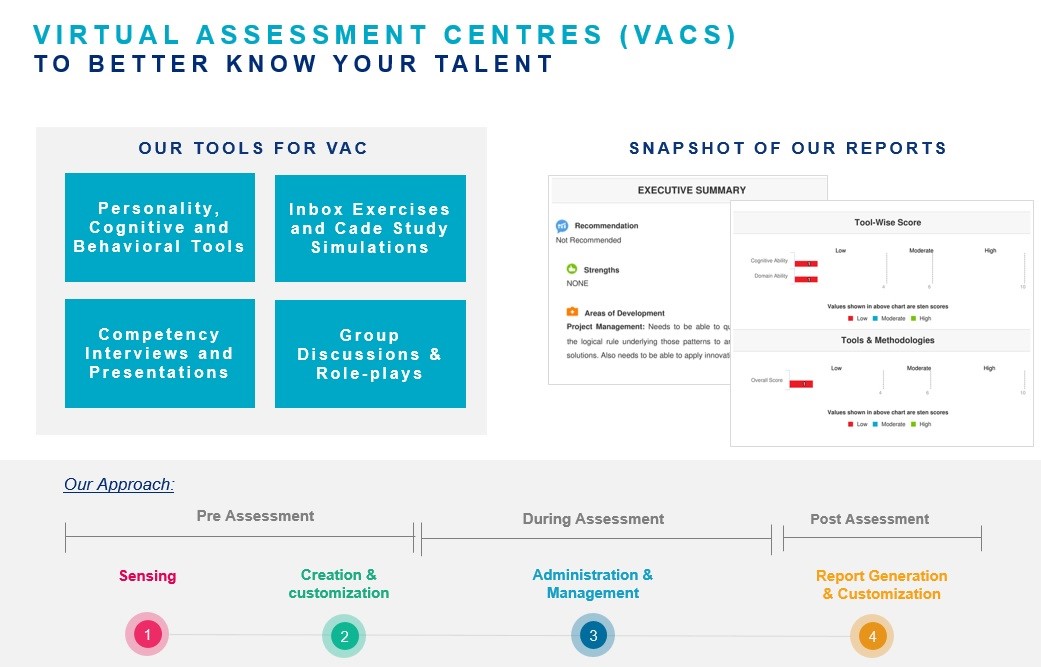
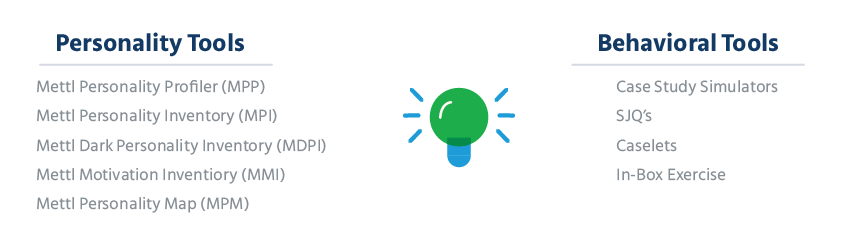
Mercer | Mettl’s expertise in leadership assessment has enabled us to devise effective leadership evaluation tools, such as Virtual Assessment and Development Centre. It is a combination of psychometric and behavioral tools, used to generate a detailed competency profile of the leader, followed by a report and insights on how to undertake individual development plans. Additionally, our psychometric assessments analyze the competency gaps in leaders and provide a holistic report on the development areas.
Originally published July 17 2020, Updated August 23 2021

A writer at heart, Megha has been in the content industry for 4 years. Starting her career from print, her journey spans across IT, legal and consulting industries. She has been associated with Mercer | Mettl as Assistant Manager, Content Marketing for 2 years.
A leadership assessment is a type of personality test used to identify and develop the competencies required in a good leader - decision-making, empathy, communication, inspiring others, etc. A leadership test can contribute to organizational planning initiatives, such as promotion decisions, succession planning, etc.

Assess & develop leadership competencies to future-proof your business
Know More

Automate Your L&D Programs With Virtual And Blended Assessment Center Development Centers
Know More

Measure the potential of your talent and make objective organizational decisions
Know More


Thanks for submitting the comment. We’ll post the comment once its verified.





 Behavioral Competencies
 Cognitive Competencies
 Coding Competencies
 Domain Competencies








Would you like to comment?